 Brandon Karpf
The First Island Kill Chain
Published on
9-minute read · 2,132 words
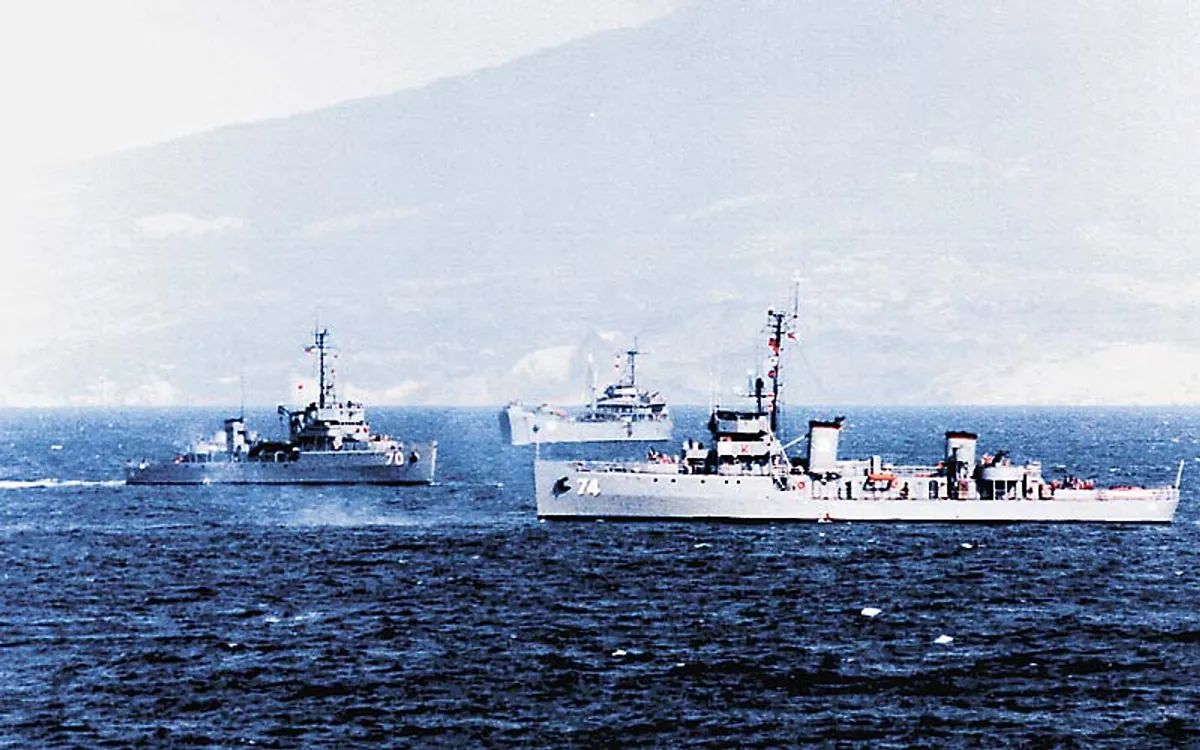
A decommissioned warship sits at sea. Towed into place by a tug. No crew aboard, no power on, anchor rust-locked, the hulk rides a long Pacific swell.
On islands close to the firing waters, missile launchers stand on prepared positions. Surveyors marked the firing points in the days before. The launchers came in under tarps and went up on quiet schedules. Manned by the young sons and daughters of three nations, the launchers reach for the same patch of water.
A missile leaves a rail. Sea-skimming, low against the water, tracking toward the hulk.
A second missile follows from a different launcher, flying a higher profile than the first. Then a third, this one supersonic in terminal phase, a decapitating strike from high noon designed to punch a hole from the top of the mast down to a detonation in the engine room. Each missile from a different flag. The integrated fires sequence across three nations on a shared schedule, a shared targeting picture, with shared rules of engagement.
The hulk takes the first hit. Then a second. The hits accumulate. The bow rides lower; the deck angles toward the sea; the hulk begins to settle.
Then it goes under.
The launchers are Philippine, American, and Japanese.
The Japanese missile is a Type 88 surface-to-ship missile, an offensive Japanese weapon fired from foreign soil for the first time since World War Two.
The hulk is the BRP Quezon.
Manuel Quezon, the namesake, led his country in exile from Australia and the United States while the Imperial Japanese Army occupied his archipelago between 1942 and 1945.
This rehearsal expresses an architecture the Western Pacific did not have a year ago. Japan is back.
Eighty Years, Seven Months
20 April 2026. Monday morning in the Philippines.
At Camp Aguinaldo in Quezon City and across half a dozen exercise sites on Luzon and the outlying islands, seventeen thousand troops are starting the largest Balikatan Military Exercise in the program’s forty-one-year history. They come from seven active-participant countries: the Philippines, the United States, Australia, Japan, Canada, France, and New Zealand. Seventeen more nations sent observers. About fourteen hundred of the troops are Japanese, deployed across Ground, Maritime, and Air components. The first combat-tasked Japanese force on Philippine soil since the Imperial Japanese Army’s surrender in September 1945.
Eighty-one years separate the two arrivals.
Corregidor fell on 6 May 1942. Japan surrendered on 2 September 1945. Between then and this morning came the postwar scaffolding the Pacific has lived inside ever since: the San Francisco Peace Treaty in 1951, the Philippines-US Mutual Defense Treaty the same year, the 1956 Reparations Agreement, the 1960 US-Japan Security Treaty, and the 2024 Japan-Philippines Reciprocal Access Agreement, which entered into force in September 2025 and provides the legal authorization for a JSDF combat unit to stand on Philippine soil this morning.
Eighty years, seven months, and a handful of days between the last Japanese combat boots to leave Philippine soil and the first one to land on it again, this time by Filipino invitation, under a treaty Filipino legislators ratified, alongside a Japanese government that funded the trip out of a defense budget Japanese voters approved.
General Romeo Brawner, the Armed Forces of the Philippines chief of staff, said at the opening ceremony, “After 1945, for the very first time, we will have again Japanese combat troops on Philippine soil.” Brawner did not soften the sentence. He used the word “again” deliberately. He used it because the moment demanded the word.
What made today possible is also what makes today meaningful for the defense of the Pacific against the growing threat from China.
The Architecture
A kill chain is the sequence by which a military finds a target, tracks it, fires on it, and confirms the kill. Doing it inside one military is hard. Doing it across three militaries, with shared sensors, shared data, shared rules of engagement, and shared willingness to release weapons under the same flag-state’s call, is an order of magnitude harder. Three navies do not run a single kill chain by accident.
The exercises during Balikatan 2026 are running one.
The architecture under it took three years to field. Walking it backward: the 2022 Japanese National Security Strategy named China as Japan’s strategic challenge in plain language, and authorized counterstrike capability for the Self-Defense Forces. The 2023 Japanese Defense Buildup Plan committed ¥43 trillion across five years and sent Japanese defense spending toward two percent of GDP, a number every Japanese government from the 1960s forward had treated as the political third rail. In December 2023, then-Prime Minister Kishida revised the export rules to authorize sale of finished lethal weapons for the first time. The Active Cyber Defense Law passed Tokyo’s Diet in 2025 and enters force on 1 October 2026. Then on 21 April 2026, Sanae Takaichi’s government expanded the weapon export authorization to seventeen partner countries with which Japan holds defense agreements, the Philippines among them. The most consequential strategic shift in the Pacific since 1960 was assembled in budget footnotes and bureaucratic releases that nobody covers because nobody is paid to cover bureaucratic releases.
I catalogued this build-up in more detail in The Quiet Rearmament. This week is what it looks like in firing position. Guns up, ready to fire.
Takaichi posted to X in the first days of Balikatan: “In an increasingly severe security environment, no single country can now protect its own peace and security alone.” That is the thesis in the Prime Minister’s own words.
The industrial layer carries the same shape as the exercise. The Global Combat Air Programme, the trilateral fighter project Japan runs with the United Kingdom and Italy, awarded its first joint contract on 3 April 2026: £686 million to Edgewing, the joint venture that will build the airframe. Tokyo’s March 2024 Cabinet decision authorized GCAP exports to third-party countries, with at least fifteen states identified as eligible buyers. Coproduction and foreign sales of offensive weapons. The defense industrial base and international coalition is growing.
Then the geometry. NMESIS launchers from the US Marine Corps’ 3rd Marine Littoral Regiment and HIMARS from the US Army’s 25th Infantry Division flew into Itbayat, the northernmost inhabited island of the Philippines, on US Air Force C-130s. Combined system range covers 100 to 300 miles. The Philippine Marine Corps brought BrahMos, live and notional, into the same firing line with an operational range of more than 500 miles. The Japanese Type 88 fires its anti-ship missile to 100 miles. Itbayat sits 100 miles from Taiwan. Four anti-ship systems, three flags, one chokepoint. Whoever sails through that water now has to assume firepower can arrive from four launch positions, on four different service command nets, with four different missile flight profiles, and therefore four different missile defense procedures, against one shared target.
Those are four fangs that change the chokepoint math.
And those are only the land shooters. Col. Dennis Hernandez, Balikatan spokesperson for the Armed Forces of the Philippines, called the SINKEX “a combination of air, land, and maritime assets sinking the target vessel” in an interview at Camp Aguinaldo. Joint and combined.
The Receipts
If you want to know whether a deterrence architecture is working, watch the adversary. Beijing starts reacting the morning the architecture goes operational.
Day one. PRC Foreign Ministry spokesperson Guo Jiakun steps to the podium in Beijing on 20 April and delivers a warning in his own voice rather than handing it to state press: “We wish to remind the countries concerned that blindly binding themselves together in the name of security will only be akin to playing with fire, ultimately backfiring upon themselves.” The “playing with fire” formula is high-register PRC rhetoric, ordinarily reserved for direct security warnings. Guo invokes the Pacific War: “Japan bears grave historical responsibilities for Southeast Asian countries, including the Philippines, due to its aggression and colonial rule during WWII.” Chinese Foreign Ministry spokespersons do not deploy WWII guilt by accident.
Day two. On 21 April, Beijing responds to Takaichi’s export-law expansion: “seriously concerned,” “reckless militarisation,” “highly vigilant and resolutely opposed.” The Global Times, the Chinese state-press paper that handles escalation when the Ministry stays calibrated, simultaneously runs a long piece featuring Zhang Junshe, a senior colonel of the People’s Liberation Army Navy, who describes the JSDF deployments as “endowed with substantive offensive combat capabilities” and characterizes Japan as “willingly acting as a pawn of the US in the Asia-Pacific region.” Two registers with the same message.
Day five. On 24 April, the PLA Southern Theater Command organizes Task Force 107, led by the Type 055 guided-missile destroyer Zunyi, and conducts live-fire drills east of Luzon: “a necessary action in response to the current regional situation.” Behind the surface action group come the carrier Liaoning and a Type 075 amphibious assault ship. A Type 055 fires a YJ-20 hypersonic anti-ship missile in the vicinity.
Around 28 April, a combined Russian-Chinese surface task group transits Japan’s southwestern approaches en route to the East China Sea.
The vocabulary China uses is borrowed from the US. In October 2023, after the Hamas attack on Israel, the Biden administration ordered the USS Gerald R. Ford carrier strike group to the eastern Mediterranean within days, then added the USS Eisenhower carrier strike group, specifically to deter Iran and Hezbollah from a wider regional war. American doctrine, expressed as deployments rather than treaties, on the theory that an adversary’s calculation changes when an aircraft carrier appears in the relevant ocean. Beijing is now running the same playbook: a carrier, an amphib, a surface action group, and a hypersonic missile fired in the vicinity. Three axes of escalation in nine days, in answer to one exercise. All deployed as deterrence theater against a multilateral kill chain that Beijing did not take seriously a year ago.
Deterrence theory says this is what a credible adversary does when it sees a credible threat. They do not wave it off. They do not dismiss it as exercise theater. They sail their own ships, fly their own missiles, and try to prove that the cost of testing the architecture has gone up. That is the adversary giving the architecture its grade.
Beijing just gave us an A+. Thank you, Japan. Keep building.
”I Shall Return”
MacArthur said it from a railway platform in Australia in March 1942, after his evacuation from Corregidor. He returned at Leyte in October 1944, two years and seven months later, with an American army that liberated the Philippines from Japanese occupation. My grandfather was with them. The architecture MacArthur came back to restore was simple in concept and brutal in execution: a Pacific in which the Philippines could exist as a sovereign country instead of as somebody’s colony.
Eighty years and seven months later, Japan is back.
This time as ally. This time as one of three nations that fired this week on a chokepoint a hundred miles from Taiwan, in defense of the same archipelago, against the next adversary that thinks the Pacific is up for grabs. The country MacArthur came back to fight is now part of the architecture MacArthur came back to build. That is what eighty years of work looks like when the work was done right.
The Pacific is safer this week than it was last week. The deterrent grew because Japan grew into it. The hub-and-spoke alliance the United States designed in 1951 cannot carry the load alone in 2026, and Japan stopped pretending the United States could carry it. Three Reciprocal Access Agreements in two years, with Australia, the United Kingdom, and the Philippines. A fourth in negotiation with France. Canada, France, and New Zealand on the Balikatan firing range as active participants for the first time, alongside Australia, Japan, the United States, and the Philippines. An export law that lets Japan sell weapons to the seventeen countries it has signed defense agreements with. A Prime Minister who publicly champions her own bilateral and multilateral defense agreements. A Self-Defense Force that fires the Type 88 from a foreign island and goes home to a country that ratified the trip.
The Type 88 launchers will leave Itbayat when Balikatan ends on 8 May. The fourteen hundred JSDF personnel will load onto Japan-flagged ships and aircraft and rotate home under the same Reciprocal Access Agreement that governed their entry. The exercise will close. The architecture stays.
The next exercise is already on the calendar. Balikatan 2027. The multilateral cycles that come whenever Beijing decides to test the architecture again. Whatever follows the day France’s RAA enters force. The Type 88 launcher on Itbayat is one weapon. The architecture turns one weapon into four, and three flags into seven. The coalition executes and maneuvers faster than the PLA can respond.
Keep going, Takaichi. Damn the torpedoes, full speed ahead.
More writing
Related writing
Three pieces tagged the same.
14-minute read
The Quiet Rearmament
National security strategist Brandon Karpf on how Japan built the world's third-largest military the way it gardens: quietly, precisely, totally.
7-minute read
The Impossible Seat
How the military operation against Iran is stress-testing Japan's security architecture, with implications for China deterrence and the March 19 Trump-Takaichi summit.

1-minute read
The playbook for outpacing China. (Source: CyberWire Research Saturday)
Brandon joined Research Saturday to sit down with Kevin Lentz of the Global Disinformation Lab and walk through a threatcasting report that maps how Indo-Pacific allies can counter China’s gray-zone cyber moves through 2035.