 Brandon Karpf
The AI Has Eaten the Pen
Published on
At 2,329 words, this post will take 9 minutes to read.
You people are driving me nuts.
It’s everywhere now. The flood is complete. I see it in bullshit LinkedIn posts, in marketing emails that promise to “unleash” my sales team’s potential, in newsletters I used to respect. I’ve seen it in corporate white papers, research reports, and, I shit you not, in articles from major newspapers.
It’s a creeping, sterile monoculture of thought and writing. It tastes like diabetes feels.
I went to Safeway yesterday. I was just picking up materials for Christmas cookies. Flour. Sugar. Marshmallows. Later, I went to Whole Foods for my actual groceries. Walking out of that Safeway, I felt a familiar, specific grossness. A lethargic grumbling. I recalled the oversaturated colors from boxes of Chips Ahoy and Cap’n Crunch. The stale smell of sugary whitebread and toll house cookies. The oiliness of the air. The nauseating lights (I swear to god there’s a puke-green hue). It was like the emotional equivalent of eating a Big Mac. It felt empty, processed, and cheap. And, side note, Safeway is not really less expensive than Whole Foods. I’ve checked. It’s just the brand. Everyone feels like it’s less expensive because it is, in the truest sense of the term, cheaper. But that’s a different polemic.
This is what it feels like to read everything you people “write.” This is the intellectual equivalent to the Diabetes Industrial Complex that made America fat and miserable. We’re being fed a constant, relentless diet of mental junk food. It’s mass-produced by scriptorial lightweights who have mistaken generation for creation. They’ve found a new, high-velocity way to make us all sick.
Sure, the pen is mightier than the sword. But the AI has eaten the pen.
A Three-Part Disease
Bad writing has always been with us, but at least people once had to try. You could respect the effort, if not the prose. We’ll get to the symptoms in a second, so bear with me. The problem is the engine, the Dark Lord. The Dark Lord knows nothing, creates nothing, and risks nothing. The engine has three first principle flaws that are damn near impossible to fix: the fact AI has no stake in the real world (no-stake sterility), the fact that AI is designed to be the average of us all (the oblivion of mediocrity), and the fact that AI has no chutzpah (the hedging engine of wimpdom).
AI has no lived experience, which means everything it writes suffers from no-stake sterility.
It has never won a fight, lost a job, or felt a room go quiet after a bad joke. It has no skin in the game. It is a sterile, detached observer of human text, and it can only mimic the shape of our ideas.
Shortly after I rented my first apartment, I was twenty two years old, cheap as hell, living in Boston, and needed a table. I ordered an inexpensive, minimalist one from Target. It was made of particle board, that fake stuff that’s discarded wood shavings and superglue. The first delivery arrived with a big chunk knocked out of its side. “Oh well,” I thought, “it was only like $40. I’ll just order another.” When the second arrived, there were so many scratches on the top that it’s entirely possible an alleycat was trapped in the box during shipping. The third arrived with a missing leg. The fourth looked much like the first. It took five deliveries to get one that wasn’t visibly broken on arrival. Five.
Four months later, I leaned on the corner while eating and the entire thing gave way. It didn’t crack. It crumbled. It collapsed into a pathetic pile of sawdust and cheap glue.
AI writing is that dining table. It’s the particle board of writing. It has the shape of an argument. It has the veneer of an insight. The second you put any real intellectual weight on it (try to find one original, falsifiable thought) it disintegrates because AI is sterile and has no stake in the real world. The AI suffers from the deepest of all epistemological flaws: it knows nothing.
AI is the average of us all, which means it writes like mediocrity is cool again (oh, hello 1996).
It’s a statistical engine. It’s unskilled at being interesting, provocative, or true. It’s designed to be probable. It finds the most likely next word, which forces every sentence to regress to a safe, boring average.
This is the Great Autotune.
I was at a tenth-grade dance in 2008. Of course we didn’t call it tenth grade, we called it the Third Form because we were pseudo-intellectual adolescents at a posh faux-British boarding school in central New Jersey. The gym smelled like sweat and floor wax (although it wasn’t actually a gym, in reality it was the lounge of our dining hall that had a slate floor and smelled legitimately like fine wood finish and… sweat). I felt like Sisyphus. I was pushing the same boulder up the hill all night. The boulder was the same six dance moves with the same rhythm and the same sounds with everyone on the dancefloor dressed in the same clothing singing the same damn lyrics. I realized… every song was the same. It was the peak of the autotune era. Lil Wayne’s “Lollipop.” Flo Rida’s “Low.” Every T-Pain track. The same tempo, the same structure, the same metallic, dead-eyed vocal correction.
It made me a great dancer. I only had to learn one song.
AI writing is autotune. It’s the sound of all human creativity being flattened into one boring, predictable, statistically-optimized track. The AI suffers from a fundamental methodological flaw: it creates nothing.
AI is spineless, which means everything it writes hedges like a politician pressed on the solvency of the social security program.
It’s a hedging engine that’s fundamentally timid. It’s programmed to be “helpful and harmless,” which is latin for “non-committal and wimpy.” It’s terrified of being definitively wrong.
We had a lieutenant at one of my old units in the Navy. We called him “The Seagull.” He’d fly in, make a lot of noise, shit on everything, and fly out. (He would also steal your fries. But again, different polemic.)
But The Seagull’s real talent was analysis paralysis. We were in a planning meeting for a complex evolution. We needed a hard “go/no-go” decision on which two elements of our unit would take the lead. They were his people, so the decision came to him. He just stared at the planning board. “Well,” he said, “it’s arguable that John and Cindy are best trained for this. But some might say that Elliot and Frank have more experience in this type of situation. But there is some risk there. On the one hand…”
As I sat there watching our Senior Chief’s head turn a shade of red reserved only for lipstick, firetrucks, and solo cups, it dawned on me that this idiot is why we might lose the next war, and that he was destined to make Admiral. His refusal to take a position was, itself, a decision. It was just the worst possible one.
AI writing is The Seagull. It’s an engine built for analysis paralysis, hiding its cowardice behind a mask of “nuance.” The AI suffers from the most unhuman of all moral flaws: it risks nothing.
A Semantic Dark Lord on his Dark Throne.
Particle board, autotune, and seagulls are all annoying parts of life. This is worse.
This is Sauron. It’s a toxic, black sludge coating every channel. It’s suffocating all native life. The weird blogs. The personal, vulnerable essays. The actual, risky thoughts.
Yesterday, I read five newsletters back-to-back. You know who you are. They were all the same story. I realized they were all written by AI. They all opened with a Vapid Gatekeeper (“In an increasingly…”). They all used a Bullet-Point Tyrant for their structure. They all made their one “profound” point using the Witch-king of “Not Just.”
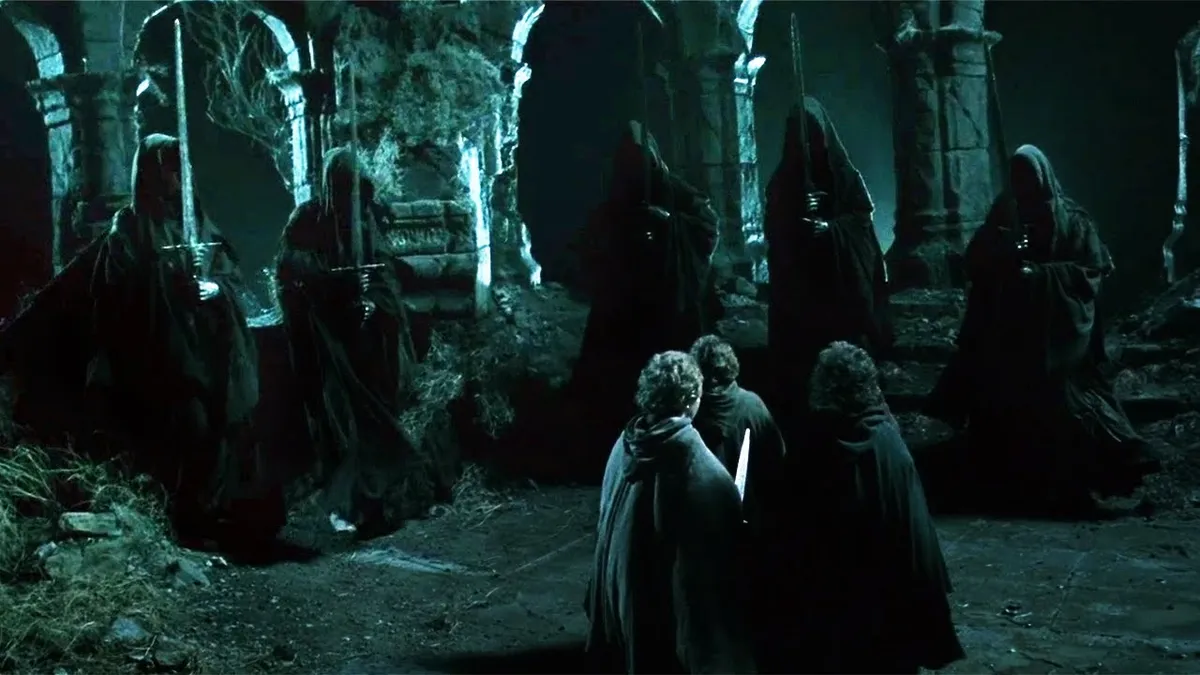
This is why I must name the agents of this Dark Lord. They are the nine Ringwraiths. Meet them and despair:
The Witch-king of “Not Just” is the worst of them all. He’s the voice behind the “It’s not just a tool, it’s a revolution” crutch. This is the laziest of all rhetorical setups, a symptom of the Hedging Engine. It’s a writer too timid to make a bold claim, so they build a straw man to knock down first. The fix is simple. Stop hedging. Just state the revolution. Only Douglas Adams was talented enough to describe something in relation to its negative.
The Vapid Gatekeeper is the “In today’s fast-paced world…” non-opening. It’s a paragraph of pure throat-clearing from a writer with no personal story to tell. This is the ultimate symptom of no-stake sterility. The AI has no 10th-grade dance to reference, so it defaults to this meaningless abstraction. The fix: Delete it. Start with your second paragraph.
Then you meet the Hollow Synergist. This is the language of the particle board table: “leverage, utilize, foster, streamline, unleash.” It’s a lexicon of abstract, corporate-approved verbs that communicate nothing specific, the sound of work being performed instead of done. The AI has never built anything, so it can only “leverage.” The fix is to use concrete verbs. Verbs with force.
The Bullet-Point Tyrant is a structural failure. It’s the lazy dumping of ideas into a list, often with randomly bolded “key points”, because the AI struggles to weave them into an argument. This is the Tyranny of the Mediocre Mean in action. A list is statistically safe. A real narrative is risky. Do the hard work. Find the thread.
The Fracturer is the em-dash epidemic. The AI learned that “smart” writers use dashes, so it uses them—everywhere—with the subtlety of a sledgehammer. It’s another symptom of the Tyranny of the Mean. It found a statistical correlation for “sophistication” and mistook it for a rule. The fix is obvious. Use a period. Let a sentence end.
The Monotonous is the sound of autotune in your writing. It’s the endless, predictable march of sentences that are all 15-to-25 words long. No pulse or rhythm. No short jabs. No long, reflective explorations. Nothing lyrical that draws unique imagery to expand the mind, open the heart, and release a flood of thrilling neurological chemicals that stimulate your limbic instincts to fuck, fight, and eat. It’s the statistical average, and it is perfectly, hypnotically dull. This is the very definition of the Tyranny of the Mean. Vary your sentence length. Aggressively.
The Unblemished is the “too perfect” text. Flawless grammar, perfect spelling, and zero personality. It’s sterile, clean, and frictionless. Because it has no flaws, it has no grip. It doesn’t break rules. Like, ever. There is no texture for a reader’s mind to hold onto. This is No-Stake Sterility by definition. The AI has no scars. The fix is to be human. Tell the flawed story.
The Non-Committal is The Seagull’s voice. This is the flood of “it’s arguable that,” “some might say,” and “to some extent.” It’s the AI’s refusal to ever plant a flag, make a falsifiable claim, and risk being wrong. This is the Hedging Engine’s primary defense mechanism. Stop qualifying. Make the claim.
Finally, there is The Needless. This is the empty scaffolding. The “It’s important to note that…” and “It’s worth mentioning…” These are the timid, obsequious tics of an engine asking for permission to make a point. They are a total waste of time. Delete the phrase. The sentence will be stronger.
I see the Wraiths everywhere, every day, and it’s driving me insane.
How We Fight
This is a two-front war. It’s about how we read and how we write.
A demand-side fix. AKA, the “Ozempic” solution. Suppress your appetite for junk food. We have to starve the beast.
Stop consuming. Unfollow the Vapid Gatekeepers. Mute the Hollow Synergists. Raise your palate. Go read a real book. Go read Didion, Zinsser, Joe Moran, Stephen King, or that dude on substack who wrote a blog analyzing if Mike Wazowski is Polish or Jewish. Go read anything with a human pulse. When you get used to real food, the junk food starts to taste disgusting. Plus, there’s functionally no difference between someone who doesn’t read and someone who can’t read.
And when you’re reading someone online and see the Ringwraiths, call it out. Mock it. Make it uncool. We have to create a cultural aversion to this sludge.
A supply-side fix. AKA, the Éowyn solution. Be aggressively human. This is how we win.
The Wraiths serve the “One Ring”: the algorithm. That is their Ring of Power. The Witch-king, their leader, couldn’t be killed by “any man.” He was undone by the unexpected. By a woman and a hobbit.
The AI is the same. It cannot quantify real vulnerability, specific failure, or weird humor. It has no defense against them.
Stop writing like a thought leader. Write like a person. Be vulnerable. Be emotional. Tell your flawed stories. Take a stand. Be courageous. Be Éowyn.
The AI ate the pen because we fed it a diet of junk. We handed it the keys. We rewarded the “Tyranny of the Average” (and the word average is really just another word for mediocre) because we were too busy, too lazy, or too scared to do the real work.
We get it back by starving the machine. We get it back by writing for people, as people.
Or…
If you can’t be bothered. If, like, committing the tiniest bit of effort to read well and write well sounds like such a chore. If you just want the easy button for your LinkedIn marketing slop, please at least add the nine Ringwraiths to the system prompt of your AI ghostwriter and instruct the AI to avoid these things like the fucking plague. If you’re gonna sin, for the love of God, at least be a better sinner.
Thanks. We all appreciate it.